Apr 20, 2026
Jamie Patrick
The Ultimate Guide to Driving in India as an American
16 min read
Despite having driven in well over a dozen countries, I felt unprepared for what to expect during my first road trip in India. I’ve written this comprehensive guide to cover all the things I wish I had known before renting a car there, including both the laws and, even more importantly, the customs of driving.
Should You Drive in India? A Realistic Assessment
Let's start with the most important question: is driving in India actually necessary for your trip?
For most first-time visitors to India, the answer is probably no. India has extensive transportation alternatives that are often more practical:
Trains: India's railway network is one of the world's largest, connecting virtually every corner of the country. High-speed trains like the Vande Bharat Express and comfortable AC sleeper coaches make long-distance travel affordable and relatively pleasant. However, train tickets often sell out, so book your tickets well in advance.
Domestic flights: Budget airlines like IndiGo, SpiceJet, and Air India Express connect major cities with low-fare flights, which are often cheaper than renting a car for multi-day trips.
Hired cars with drivers: This is the secret weapon for traveling in India. A car with a professional driver costs remarkably little by Western standards. It’s often $40-80 per day including the driver's accommodation and meals. Your driver knows the roads and customs, so you can relax.
App-based rides: Uber and Ola (India's homegrown equivalent) work well in cities and are incredibly affordable. A ride that would cost $30 in an American city might be $3-5 in India.
Auto-rickshaws: Three-wheeled taxis are perfect for short urban trips and navigating congested areas where cars struggle.
When Driving Yourself Makes Sense
That said, there are scenarios where driving yourself can be valuable:
Remote areas with limited driver availability (certain parts of Ladakh, Spiti Valley, Northeast India)
Extended stays where you want complete flexibility and the freedom to stop whenever and wherever you want.
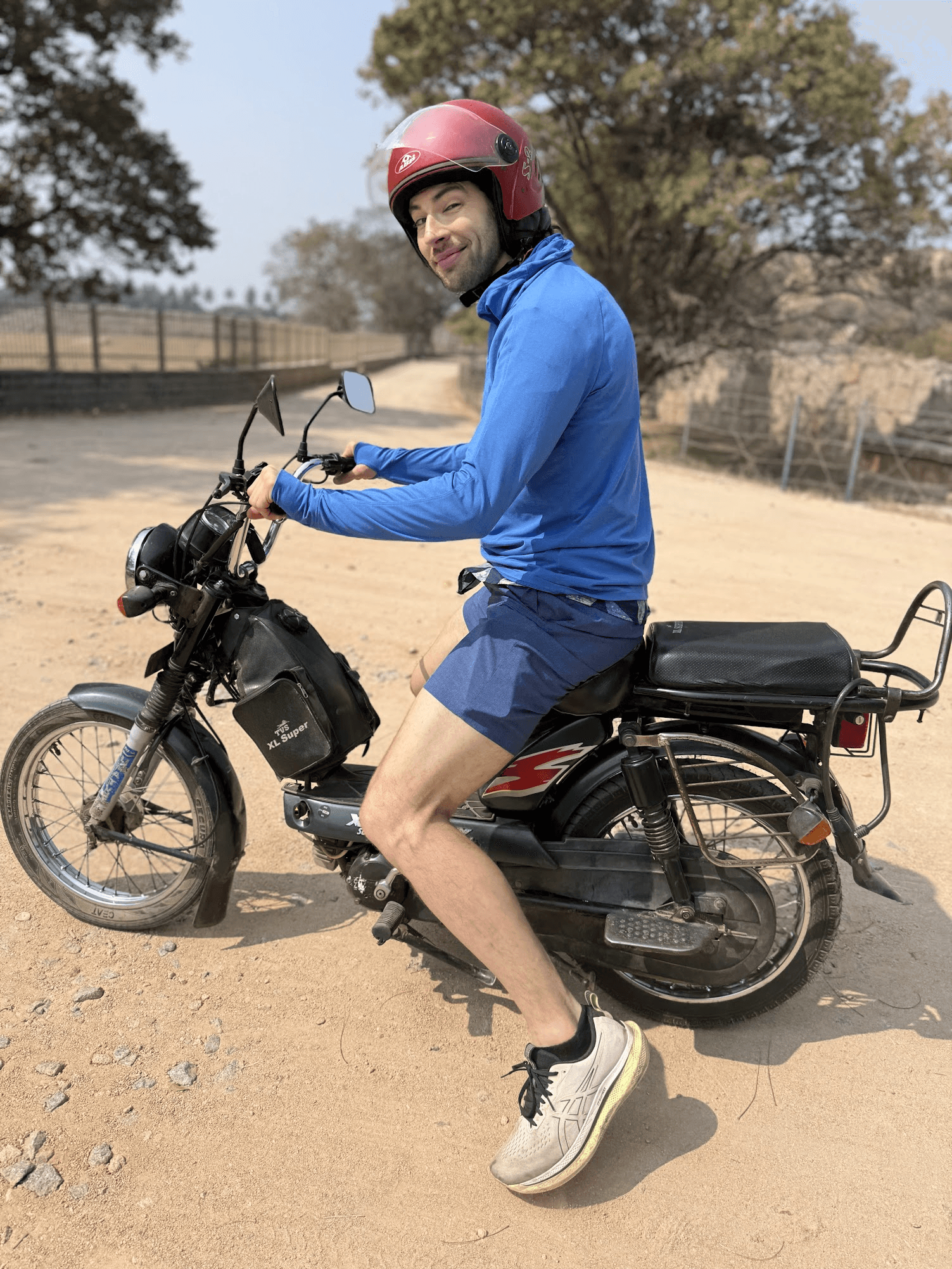
Motorcycle touring (popular in Rajasthan, around the Himalayas, and coastal regions) for experienced riders seeking adventure
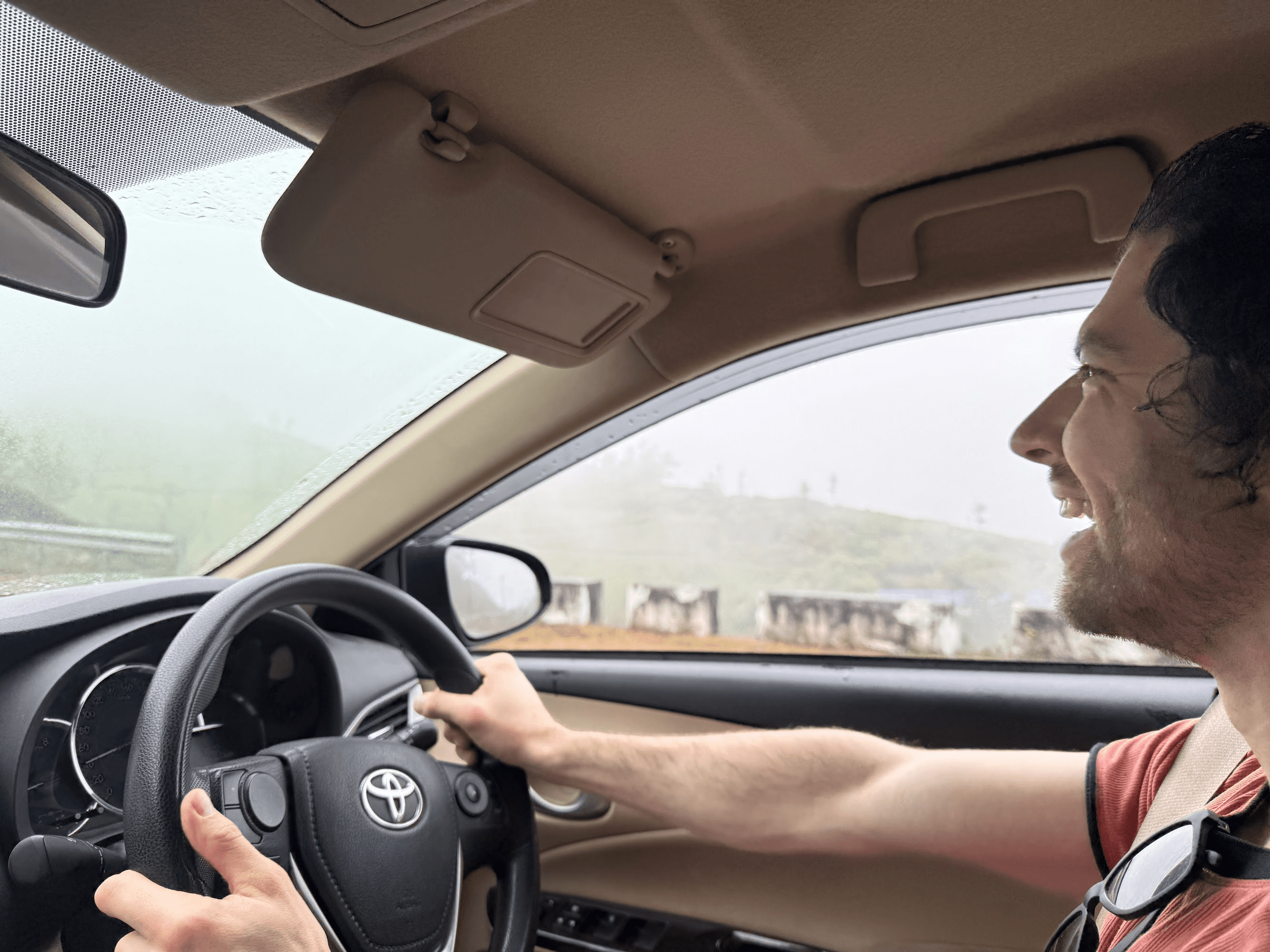
Goa and Kerala, where traffic is relatively manageable and tourists commonly self-drive. I chose to rent when road tripping Kerala between Kochi and Munnar (see photo below).
Hill stations and mountain regions where the driving itself is part of the experience
If you're considering driving in India, I strongly recommend starting with an easier region (Goa, Kerala, Rajasthan outside major cities) rather than jumping straight into Delhi or Mumbai traffic.
Licensing Requirements: An IDP is Needed
Americans need an International Driving Permit (IDP) to legally drive in India. Your U.S. driver's license alone is not sufficient.
The Legal Framework
India is a party to the 1949 Geneva Convention on Road Traffic, which means it recognizes International Driving Permits from contracting countries including the United States, but explicitly does not recognize foreign driver's licenses by themselves.
Real-World Enforcement
While enforcement can be inconsistent, some rental companies are lax about checking, and some tourists drive without IDPs without issue, the risks of not having one are substantial:
Legal penalties and fines if stopped by police
Insurance complications if you're involved in an accident (your coverage may be void without proper licensing)
Rental difficulties as most legitimate rental companies officially require an IDP
Police checkpoint problems, which are common on highways and near state borders
As a personal anecdote, I’ve rented vehicles twice in India, and was only asked by the rental company once for my IDP. I’ve never been stopped by the police, so I don’t have any personal experiences to go off of in terms of if the police will ask for the IDP.
How to Get an IDP
The process is straightforward for Americans:
Option 1: AAA (American Automobile Association)
Can be done in person at AAA offices or by mail
Cost: $20, plus $10-30 for two passport photos, plus shipping if not done in person
Processing time: Immediate in person, at least one week if applying online
Valid for one year from issue date
Online applications done through the AAA website are processed through govWorks, a third party which has awful reviews. Customers have repeatedly come to us after bad experience including not ever receiving an IDP after ordering from them.
Option 2: AATA (American Automobile Touring Alliance)
Similar process and cost to AAA, though no in-person options
Better reputation for customer service and reliability than AAA/govWorks
Option 3: Fast IDP (that's us - the faster option for AAA-issued IDPs)
As of when this blog was published, Fast IDP is the only International Driving Permit expediter working in the United States that gets official AAA-issued or AATA-issued IDPs.
Delivery timeline: As fast next-day delivery for rush service within the US. 2-5 business days abroad.
Useful if you're leaving soon and can't wait for AAA or AATA.
Critical Note: Don't Get Scammed
Be wary of scam websites offering "instant digital IDPs." Legitimate IDPs are physical documents with a booklet format containing translations in multiple languages.
For more details on the various IDP options, see the blog post we wrote about How to Get an IDP in the US.
What to Bring When Driving
Always carry these documents while driving:
International Driving Permit
Valid U.S. driver's license (the IDP is not valid alone; both are required together)
Passport with valid Indian visa
Rental agreement
Vehicle registration papers (provided by rental company)
Insurance certificate (provided by rental company)
Keep physical copies and digital backups. Police checkpoints are frequent, and you'll be asked for documents regularly.
What to Expect When Driving in India
Understanding the Left-Hand Driving System
India drives on the left-hand side of the road. For Americans accustomed to right-hand driving, this requires significant mental adjustment.
Adjustment Strategies
Practice in a quiet area first before entering traffic
Verbalize which side of the road you should be on when making turns
Pay extra attention to lane position in the first few days, as Americans tend to drift too far left
If renting a manual transmission, remember the gear shift is now on your left (operated with your left hand), which feels backward
Most Americans adjust within 2-3 days, but those first days require intense concentration.
The Reality of Indian Traffic: What to Actually Expect
This is where guidebooks often fail to convey the reality. Indian traffic operates on principles that seem chaotic to Western eyes but actually follow an internal logic once you understand it.
The Fundamental Principle: Fluid Negotiation
Indian traffic is based on constant negotiation of space rather than strict adherence to rules. Think of it as water flowing around obstacles. Vehicles, pedestrians, animals, and motorcycles all flow together, constantly adjusting to each other's movements.
Lane Discipline (Or Lack Thereof)
Lane markings are suggestions at best. On a two-lane road, you'll regularly see three or four vehicles abreast, with the middle space being used for passing by vehicles coming from either direction. On a three-lane highway, there might be six lanes of traffic. Vehicles will create lanes wherever space exists.
Vehicles pass on both sides. Unlike in the U.S. where passing on the right is frowned upon, in India vehicles will overtake wherever there's space.
The Horn: Your Primary Communication Tool
In Western countries, the horn signals anger or emergency. In India, the horn is your constant companion and primary communication device.
You'll see signs on trucks saying "Horn OK Please" or "Blow Horn." This isn't sarcastic, as they genuinely want you to honk before overtaking so they know you're there.
When to use your horn in India:
Before overtaking any vehicle
When approaching a blind curve on a mountain road
When approaching intersections where visibility is limited
When pedestrians or animals are near your path
When you're in someone's blind spot
Basically, whenever you want others to know you're present
How to use it: Light, frequent taps rather than long blasts. A quick "beep-beep" says "I'm here" without aggression. Long honks are for emergencies or strong warnings.
The constant honking will seem maddening at first, but you'll quickly learn it's essential for safe navigation. Embrace it.
The Vehicle Hierarchy
Indian traffic operates on an unspoken hierarchy based primarily on size and mass:
Trucks and buses (they yield to nothing)
Cars and SUVs
Auto-rickshaws and small commercial vehicles
Motorcycles and scooters
Bicycles
Pedestrians
Animals (cows, particularly, have special status and are never rushed)
Larger vehicles have de facto right-of-way regardless of traffic rules. A bus making a turn into your lane will do so whether you're there or not.
Sharing the Road: The Cast of Characters
Indian roads are shared spaces in ways American roads aren't:
Vehicles you'll encounter:
Trucks (often overloaded and slow)
Buses (aggressive and fast)
Cars and SUVs
Auto-rickshaws (three-wheeled taxis, ubiquitous and maneuverable)
Motorcycles and scooters (often carrying entire families)
Tractors and farm equipment
Cycle-rickshaws (human-powered)
Hand-carts and pushcarts
Electric rickshaws
Bicycles
Living obstacles:
Cows (sacred in Hinduism, they have absolute right-of-way and will lie in the middle of roads)
Buffalo
Goats and sheep (often in herds crossing roads)
Dogs (street dogs sleeping on warm pavement at night are a serious hazard)
Camels (in Rajasthan)
Monkeys (near temples and forests)
Human activity:
Pedestrians crossing anywhere and everywhere
Street vendors setting up on road shoulders
Children playing
Wedding processions blocking entire roads
Religious processions
Fruit and vegetable markets spilling into streets
Speed and Flow
Despite the apparent chaos, traffic usually moves slower than you expect. Average speeds in cities might be 15-25 km/h (10-15 mph) due to congestion. On highways, you'll average 50-70 km/h (30-45 mph) rather than the posted limits due to traffic, road conditions, and obstacles.
Journey times are unpredictable. A trip that should take two hours might take three or four. Always build in substantial buffer time.
Road Infrastructure
National Highways and Expressways
India has invested heavily in highway infrastructure over the past decade, and many highways are now genuinely excellent:
Golden Quadrilateral: The highway network connecting Delhi, Mumbai, Chennai, and Kolkata is largely high-quality divided highway, though sections pass through towns and cities.
Expressways: New access-controlled expressways like the Mumbai-Pune Expressway, Yamuna Expressway, and Delhi-Meerut Expressway are world-class and comparable to American interstates.
National Highways: Highly variable. Some sections are smooth four-lane divided highways; others are two-lane roads in poor condition sharing space with local traffic.
Toll plazas: Common on highways. Tolls are reasonable by Western standards (₹50-300/$0.60-3.50 for most segments) and can usually be paid by cash or FASTag (electronic toll collection system, which rental cars should have).
State Highways and Rural Roads
State highways range from good to terrible depending on the state's finances and priorities. Kerala and Gujarat generally have better state highways than Bihar or Uttar Pradesh, for example.
Watch for sudden hazards:
Speed breakers (speed bumps) appear without warning, even on highways
Potholes large enough to swallow a tire
Broken pavement edges where asphalt ends abruptly
Unmarked construction zones
Roads that simply end or turn to dirt without notice
Mountain Roads
India's mountain roads are spectacular but demanding:
Himalayan highways (Manali-Leh, routes to Spiti, Sikkim) are narrow, unpaved in sections, prone to landslides, and can be closed by weather. They're also breathtakingly beautiful and attract adventure drivers from around the world.
Ghats (mountain passes) in the Western and Eastern Ghats involve endless hairpin curves with steep drops and minimal guardrails. They're typically paved but narrow.
Essential for mountain driving:
Know how to drive a manual transmission (most vehicles are manual, and you need engine braking)
Uphill traffic has right-of-way on single-lane sections
Use horn liberally on blind curves
Travel during daylight only
Check weather and road conditions before attempting
Carry warm clothes and emergency supplies
Speed Limits and Traffic Enforcement
Official speed limits exist, but enforcement is inconsistent compared to Spain or the U.S.
Posted Limits
Urban areas: 40-50 km/h (25-31 mph), though rarely enforced
Highways: 80-100 km/h (50-62 mph) depending on the type
Expressways: 100-120 km/h (62-75 mph)
These limits are often ignored, though reckless driving can attract police attention.
Enforcement Methods
Police checkpoints are the primary enforcement mechanism rather than speed cameras. These checkpoints:
Are common on state borders, near cities, and on major highways
Check documents (license, registration, insurance, permit if crossing states)
May conduct sobriety checks
Sometimes involve corruption (see section below on dealing with police)
Speed cameras exist in some cities and on some highways but are far less common than in Europe.
Traffic police in cities enforce major violations but often ignore minor infractions due to the sheer volume of traffic.
Important Traffic Rules
Drinking and driving: India has very strict laws with a legal limit of 0.03% BAC (much lower than the U.S.'s 0.08%). Police conduct sobriety checkpoints, especially on weekends and holidays. Penalties include fines of ₹10,000 ($120) and possible imprisonment for repeat offenses.
Seat belts: Mandatory for driver and front passenger. Rear seat belt laws exist but are rarely enforced. The fine is typically ₹1,000 ($12).
Helmets: Mandatory for all motorcycle riders and passengers. The fine is typically ₹1,000-2,000.
Mobile phones: Handheld use while driving is prohibited. The fine is typically ₹1,000-5,000. However, enforcement is minimal.
Document requirements: Carrying your IDP, license, insurance, and registration is mandatory. Police can fine you ₹5,000 for driving without proper documents.
Navigating Indian Cities: Special Challenges
Major Metropolitan Areas
Delhi: Possibly the most challenging driving environment in India. Aggressive drivers, complete disregard for lanes, constant honking, and overwhelming congestion. If possible, use the Metro system, which is excellent, instead of driving in central Delhi.
Mumbai: Dense traffic, narrow streets, and aggressive drivers. Parking is nearly impossible. The cab system works well for getting around.
Bangalore: Notorious for some of India's worst traffic jams. Plan for extreme travel times. One-way systems and road layouts change frequently.
Kolkata: Narrow streets, hand-pulled rickshaws, trams, and dense pedestrian traffic. Very difficult for driving.
Chennai: Aggressive drivers and two-wheeler-heavy traffic. Flooding during monsoon season can make roads impassable.
Mid-Size Cities
Cities like Jaipur, Kochi, Pune, and Udaipur are more manageable but still challenging. Old city areas have narrow lanes designed for pedestrians and carts, not cars.
Small Towns and Villages
Advantages: Less traffic, more forgiving of mistakes, locals often helpful to lost tourists.
Challenges: Roads may be poorly maintained, livestock more common, street layouts confusing, and GPS may not have accurate maps.
Parking in India
Parking operates differently than in Western countries and involves strategies most Americans haven't encountered.
Types of Parking
Paid parking lots: Available in cities, shopping areas, and tourist sites. Attendants provide tickets. Fees are minimal by Western standards (₹20-100/$0.25-1.25 for a few hours).
Street parking with attendants: Informal parking attendants (often not officially employed) will gesture you into spaces and "watch" your car. It's customary to tip ₹10-20 when you return. Don't refuse their help out-of-hand, as they often genuinely do provide a service and reduce theft risk.
Hotel parking: Most hotels have parking, from simple outdoor spaces to secure compounds. Verify availability when booking in cities.
No-parking zones: Marked by yellow lines or "No Parking" signs. Vehicles can be towed or wheel-clamped, and retrieval is a bureaucratic nightmare.
Parking Customs
Your car will likely be touched, climbed on, or used as a seat by locals in crowded areas. This is normal and not considered rude.
Cars park in creative ways that would be illegal elsewhere—on sidewalks, partially blocking roads, facing opposite directions on one-way streets.
Parking attendants may rearrange cars to fit more vehicles. This is why leaving your car unlocked (or giving keys to attendants) is sometimes necessary. Use steering wheel locks for added security if concerned.
Motorcycle parking is often haphazard. Don't be surprised to be blocked in by scooters.
Fuel: Types, Costs, and Availability
Fuel Types
India uses similar fuel terminology to Europe:
Petrol: Gasoline/unleaded fuel
Diesel: More common than in the U.S., as many Indian cars are diesel due to better fuel economy
CNG (Compressed Natural Gas): Common in cities for taxis and auto-rickshaws, but rare for rental cars
Critical: Verify your rental car's fuel type before filling up. Diesel cars are very common in India, unlike in the U.S.
Fuel Stations (Petrol Pumps)
Major chains: Indian Oil, Bharat Petroleum (BP), Hindustan Petroleum (HP), Reliance, Shell. All are reliable.
Full service: Most fuel stations are full-service, not self-service. An attendant will fill your tank. Tipping ₹10-20 is customary but not required.
Costs: Fuel prices are regulated by the government and vary by state. As of 2026, expect:
Petrol: ₹95-110 per liter ($4.50-5.25 per gallon equivalent)
Diesel: ₹85-95 per liter ($4.00-4.50 per gallon equivalent)
Availability: Fuel stations are common on highways and in populated areas but can be 50-100 kilometers apart in remote regions (Rajasthan desert, mountain areas, Northeast). Fill up when you can rather than waiting until you're running low.
Payment: Cash is widely accepted. Credit cards are accepted at major stations, but small rural stations may be cash-only. UPI (India's digital payment system) is increasingly common.
Important Tip: Watch the Meter
Fuel station scams exist. Watch the attendant:
Reset the meter to zero before pumping
Actually pump the requested amount (not stop short)
Charge the correct price
This isn't universal, but it's common enough to warrant attention, especially at highway stations where tourists are obvious.
Renting a Car in India
Major Rental Companies
International companies:
Hertz (limited presence)
Avis
Budget
Indian companies:
Zoomcar (peer-to-peer car sharing, popular with young travelers)
Myles
Revv
Carzonrent
Where to rent: Major airports and cities have rental counters. Smaller cities may require advance booking. Many travelers book through aggregator sites like Kayak or directly with Indian companies like Myles, Revv, Carzonrent, or Zoomcar (peer-to-peer car sharing, popular with young travelers).
Rental Requirements
Valid passport
International Driving Permit
U.S. driver's license
Credit card (debit cards often not accepted for deposit)
Minimum age: Usually 21-25 depending on company and vehicle type
Inspect the Vehicle Carefully
Before accepting a rental car:
Document all existing damage with photos and video
Check that all documents (registration, insurance, pollution certificate) are in the car
Verify the fuel type and current fuel level
Test all lights, wipers, and horn (essential!)
Check for spare tire, jack, and warning triangle
Note any missing parts or damage to prevent being charged later
Common issues:
Scratches and dents are nearly universal, so ensure they're documented
Air conditioning may not work well
Suspension may be worn from poor roads
Horn may be weak from frequent use
Insurance
Types of Coverage
Third-Party Liability: Legally required for all vehicles. Covers damage you cause to others. This is included in rentals but has limited coverage amounts.
Comprehensive/Own Damage: Covers damage to your rental vehicle.
Personal Accident Cover: Covers your medical expenses. India's medical system varies dramatically in quality, and you may need emergency evacuation. Your travel insurance should include substantial medical coverage.
Important Insurance Notes
Your U.S. auto insurance doesn't usually cover you in India
Most U.S. credit card rental car coverage doesn't apply to India (or only covers specific card types)
Rental company insurance is expensive but often the most practical option
Read the fine print on coverage limits, deductibles, and exclusions
Driving without an IDP may void all insurance coverage
Safety
India has one of the world's highest traffic fatality rates. According to government data, roughly 150,000 people die in traffic accidents annually. This isn't meant to terrify you, but to emphasize that defensive driving is essential.
Dealing with Police and Checkpoints
Police interactions are common when driving in India. Understanding the system helps navigate these encounters. Common checkpoint locations include state border crossings, highway checkpoints at random points along major highways, city entry points, and sobriety checkpoints (particularly on weekends and evenings).
What to Do When Stopped
Pull over safely when signaled
Have documents ready: IDP, U.S. license, passport, rental agreement, insurance
Stay in the vehicle unless asked to exit
Answer questions briefly and honestly
Don't volunteer information beyond what's asked
Stay calm: Checkpoints are routine, not necessarily indicating you've done something wrong
The Corruption Reality
This is uncomfortable to discuss, but it's a reality: some police may solicit bribes for minor or fabricated infractions.
If asked for a bribe:
Ask for a written ticket/challan (official receipt) for any alleged violation
Politely ask to go to the police station to pay the fine officially
Don't carry large amounts of cash. If you show you only have small bills sometimes ends the interaction
Remain polite but firm
Common pretexts for bribes:
"Your documents are not in order" (when they are)
Fabricated speed violations
"Wrong route" or area restrictions
Most police interactions are legitimate, but be aware that corruption exists.
What to Do in an Accident
If you're involved in an accident:
Stay at the scene: Leaving is illegal and will cause massive problems
Check for injuries: Call 108 (ambulance) if needed
Contact police: Call 100 (police) for any accident with injuries or significant damage
Document everything:
Photos of all vehicles, damage, road position
Video of the scene
Contact information of all parties
Witness information and statements
Note road conditions, lighting, traffic signs
Contact your rental company immediately
Do not admit fault: Let insurance and police determine responsibility
Get a police report (FIR—First Information Report): Essential for insurance claims
Avoid crowd interference: Accidents attract crowds who may not be helpful
Contact your embassy if the accident is serious or you're arrested
Notify your travel insurance as soon as possible
Important Legal Notes
Hit-and-run is a serious crime in India
If there's a fatality, you may be detained regardless of fault until investigations complete
Legal processes are slow, so you may need to remain in India for extended periods for serious accidents
This is another major argument for hiring a driver, as they handle accident procedures and legal issues.
Navigation and Technology
GPS and Maps
Google Maps works well in most of India and is the primary navigation tool. However:
Offline maps are essential because connectivity can be spotty in rural areas
Road closures and conditions aren't always updated
Mountain roads may show routes that are technically roads but practically impassable
Village roads may not be accurately mapped
One-way streets aren't always correctly marked in the app
Maps.me is a popular alternative using OpenStreetMap data, works entirely offline, and sometimes has better detail for rural areas and hiking trails.
Apple Maps works but has less detail than Google Maps in India.
Mobile Connectivity
Indian SIM cards are cheap and highly recommended:
Jio, Airtel, and Vodafone-Idea are major carriers
4G coverage is good in populated areas
Prepaid plans with data cost ₹200-700 ($2.50-8.50) for monthly plans with substantial data
Purchase at airports or phone shops with passport copy and photo
Activation can take a few hours
Tourist SIM cards are available at major airports with simplified registration.
Useful Apps for driving/traveling in India
Google Maps: navigation
Zomato: finding restaurants
Ola/Uber: ride-hailing if you need a break from driving
Paytm/Google Pay/PhonePe: digital payments (widely used)
PetrolMitra: finding fuel stations
Park+: parking assistance in some cities
Meru Cabs: taxi bookings
Conclusion
Driving in India can offer freedom and an unforgettable experience (at least it was for me), but requires preparation and a significant amount of adjustment.
For many travelers, hiring a car with driver provides 90% of the benefits of driving with 10% of the stress. For adventurous souls willing to embrace the chaos, self-driving in India can be one of the most memorable aspects of an Indian journey, though.
Whatever you choose, approach it with humility, patience, and respect for local customs. Master the art of the horn. Accept that cows have ultimate authority. And remember that especially when driving in India, the journey truly may be more memorable than the destination.
सुरक्षित यात्रा करें (Surakshit yatra karen) – Hindi for Travel safely!