Apr 20, 2026
Jamie Patrick
Driving in Japan: The Complete Guide for Americans
7 min read
Although most people visiting Japan have a great time traveling around on Japan's top-notch trains and public transit systems, experiencing Japan by car has allowed for me to make some of my favorite memories in the country, allowing for the freedom to explore hidden gems that public transportation might not reach. Plus, for families or groups, renting a car can be more cost-effective than buying multiple train tickets.
However, driving in Japan as an American requires preparation. This guide will help you navigate the rules, requirements, and cultural nuances of driving in Japan.
You Need and International Driving Permit
American travelers must carry an International Driving Permit (IDP) issued under the Geneva Convention of 1949. IDPs are valid for 1 year and always must be accompanied by a valid US driver’s license. IDP requirements are based on the country where your driver’s license is issued, so this section pertains to all people with a driver’s license issued in the United States, regardless of their citizenship.
How to Get an IDP for Japan
1. In person at AAA
The least expensive method to get an IDP is to visit a AAA location in person. While this option is the most time consuming, if you arrive an hour before AAA closes, you will be able to get an IDP the same day.
Steps to obtain an IDP in person:
Gather your US driver’s license, payment method, and recent passport photos (optional).
Find a nearby AAA location and visit during operating hours.
Fill out AAA’s IDP application form, either ahead of time or while you wait.
If you didn’t bring passport photos, AAA can take them for you for an additional $10-30 fee, depending on the branch.
Pay $20 for processing the IDP – cash, check, and credit/debit card are accepted.
Be prepared to wait up to 2 hours for the process to be completed (though it's usually significantly faster), but after that you should be able to walk out with your IDP.
2. Online through AAA/govWorks
AAA now offers an online application option through their partner govWorks, which is linked on the AAA website. Though this can work, govWorks has terrible customer reviews (scan for IDP reviews) and customers have repeatedly come to us after they're frustrated by this company or their IDPs aren't delivered.
Steps to get an IDP online from AAA:
Apply: visit the AAA website and complete the online IDP application, hosted by govWorks. Upload a digital passport photo and photos of the front and back of your driver's license
Pay: ~$40-$260 ($20 for the IDP booklet, plus $10 for photo processing, and ~$10 to $220+ for shipping)
Wait: 7-15 business days (5 for processing, 2-10 for shipping)
3. Online through AATA
AATA (the American Automobile Touring Alliance) is the second organization authorized by the US government to issue IDPs to American drivers. Like AAA, AATA offers an online application process, though is significantly more reliable based on what we have heard.
Steps to get an IDP online from AATA:
Apply: Visit the AATA website and complete their online IDP application. Upload a digital passport photo and photos of the front and back of your driver's license
Pay: $41-192 (currently $20 for the IDP booklet, plus $7 for photo processing, and $14 to $165 for shipping)
Wait: 6-14 business days (up to 4 for processing, 2-10 for shipping)
4. Online through Fast IDP (the fastest delivery option)
If your timeline is too short to apply online through AAA or AATA, using Fast IDP to expedite your IDP allows you to get an IDP as soon as the next day with the peace of mind that comes with our 5.0/5 average customer reviews.
Steps to obtain an IDP using Fast IDP:
Apply: Follow the link to fill out the application on our website. Upload a digital passport photo (selfie are okay) and photos of the front and back of your driver's license. The Fast IDP team will review your documents for completeness and reach out to you if they see anything you need to adjust in your application.
Pay: $84-234 (all-in, including all fees and taxes). Our base price is higher because we have to pay AAA $20 for the permit from them and go to their offices for processing.
Wait: We'll delivery your IDP to you as soon as the next business day for US addresses. For international addresses, the fastest delivery timeline is typically 2-5 business days, depending on where your IDP is going. Tokyo is deliverable within 2-3 business days from the US, most other major cities are deliverable within 3 business days, and Hokkaido and Osaka typically take 4-5 business days for delivery. Reach out to us directly if you'd like to know how long it will take to get to your destination. After you apply, you'll get an email the evening your IDP is sent with your tracking information and a picture of your IDP.
Avoid Fake IDP Scams
There are many companies online that claim to issue international driving permits, which they may also call international driver’s licenses. None of these companies offer legitimate IDPs for Americans, and Japanese rental companies will not allow you to rent a vehicle if you have an IDP that was not printed by either AAA or AATA. (We at Fast IDP expedite IDPs from AAA.) We frequently receive applications for IDPs from customers in Japan who unwittingly bought a fake IDP and were denied a vehicle at the rental counter. See our blog post about the topic here.
Penalties for Driving without an IDP
Japan doesn’t mess around with requiring IDPs! Japan enforces their International Driving Permit policy more strictly than probably any other country in the world. By law, people caught driving without a valid International Driving Permit in Japan can be subject to fines of up to 500,000 yen (about $3,500), imprisonment of up to 3 years, and/or deportation. Although the severity of the punishment can vary, every incident we’ve heard of in which a person was caught driving without a valid IDP has resulted in a hefty fine and not being able to drive the vehicle after the traffic stop - meaning that the car was either impounded or, in a few lucky cases, a properly licensed driver took over the wheel.
Rental Car Requirements
Rental car companies require you to bring all the following in order to rent a car:
Your passport
A valid U.S. driver’s license
Your physical IDP booklet (only the official IDP from AAA is accepted in Japan)
A form of payment (American credit cards are accepted almost everywhere in Japan and are fine to use when renting a car)
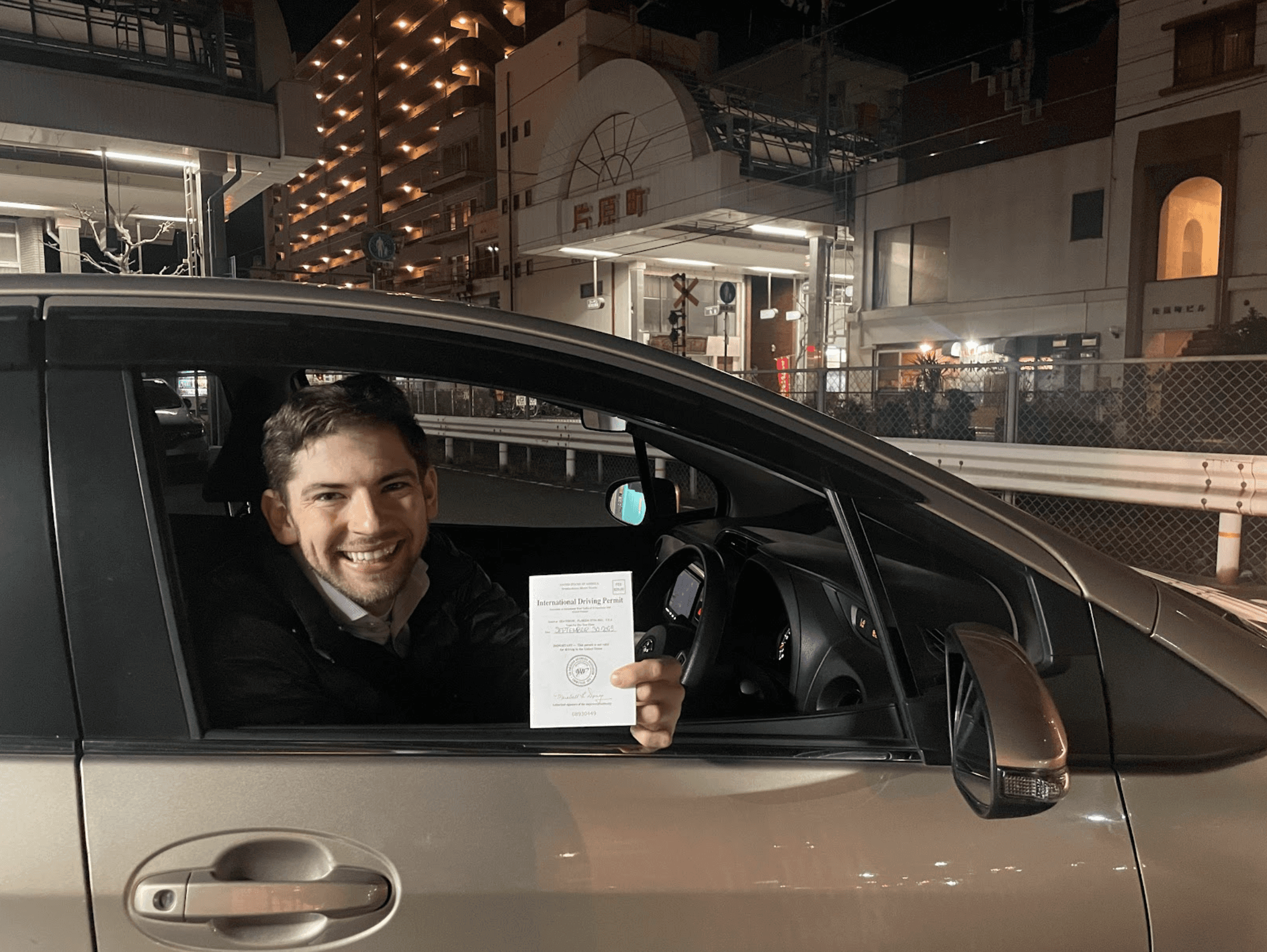
That's me (Jamie) in Japan posed with my International Driving Permit. Make sure you get an IDP to drive in Japan!
Understanding Unique Japanese Road Rules
Driving in Japan will feel very foreign at first, but these guidelines will help cover the basics of what’s different:
Drive on the Left: Japan’s roads follow left-hand traffic, so the driver’s seat is on the right. Get used to looking to your left to see the rearview mirror. Thankfully, the accelerator and brake are on the same sides as they are in the United States.
Speed Limits: Generally, city roads have a speed limit of 40-60 km/h (25-37 mph), and most highways are limited to 80-100 km/h (50-62 mph). Japan is covered with speed cameras, so be sure to watch your speed carefully, especially considering there’s no consistent amount you can exceed the speed limit by before being ticketed. Exceeding the speed limit by more than 18 miles per hour on city streets or 24 miles per hour on the highway constitutes criminal speeding instead of a normal traffic violation, resulting in serious fines, potential impounding of your vehicle, and potential jail time.
No Left Turns on Red: Unlike most parts of the U.S. where you can turn on a red light (albeit, it's a right-hand turn since we drive on the right in the US), you cannot turn left on a red light in Japan unless explicitly permitted. Many intersections have enforcement cameras, so make sure that you pay attention to this rule.
Passing on the Right: On multi-lane highways, the right lane is designated as the passing lane. Make sure that you abide by this rule, as police will actually ticket drivers for staying in the right lane for too long and sometimes for passing on the left.
Child Seats: Children under six years old must use an appropriate child seat.
Zero Tolerance for DUI: Any amount of alcohol or drugs in your system can lead to severe penalties.
Navigating Toll Roads
Japan has an extensive network of expressways that require toll payments. This can seem daunting to first-time drivers, but it’s not too difficult to navigate once you get the .
How to pay for tolls:
ETC Card: Most rental cars offer an ETC (Electronic Toll Collection) card option, which automatically charges tolls. Your rental company will charge a convenience fee on top of the toll amount. If you want to avoid the rental car’s fee on the tolls, you can purchase your own ETC card, but you will need a Japanese credit card to buy it. Tolls vary from $0.20-$1.00/mile on the highway, so they can expensive quite quickly. You can visit this site, which will show you how to calculate tolls for your exact route.
Expressway Passes: For travelers, you can purchase regional passes that give you unlimited access to a particular regional highway for a flat fee. Buying one or multiple Expressway passes can considerably reduce your toll fees. Most major rental car companies are vendors of Expressway Passes, so ask them for pricing and advice for your particular route.
Cash payment: Toll booth stations have booths set up to accept cash. Although it’s rarely written in English, booths that accept cash have a sign with a green background and booths that accept ETC have a sign with a blue background and the words “ETC” on them.
Parking in Japan
Parking can be more difficult to come by in Japan than in the United States, so it’s best to have a plan. Keep these things in mind:
Make sure you know how to use “locking plate” lots where a metal plate locks your car in place until payment. Slowly roll into these lots when you get into the parking lot, and then when leaving, check that the locking plate has lowered after you have paid to assure that you don’t damage your car.
Unlike the United States, parking is not allowed on the sides of roads unless marked. Even if a road is wide enough for a car to be parked on the shoulder, it is still illegal to park there.
Avoid illegal parking; fines are hefty, your rental car company may charge additional fees, and your car may be towed in short order in some places. If you’re in doubt about parking somewhere, the answer is probably no, but you should ask a local to find out for sure!
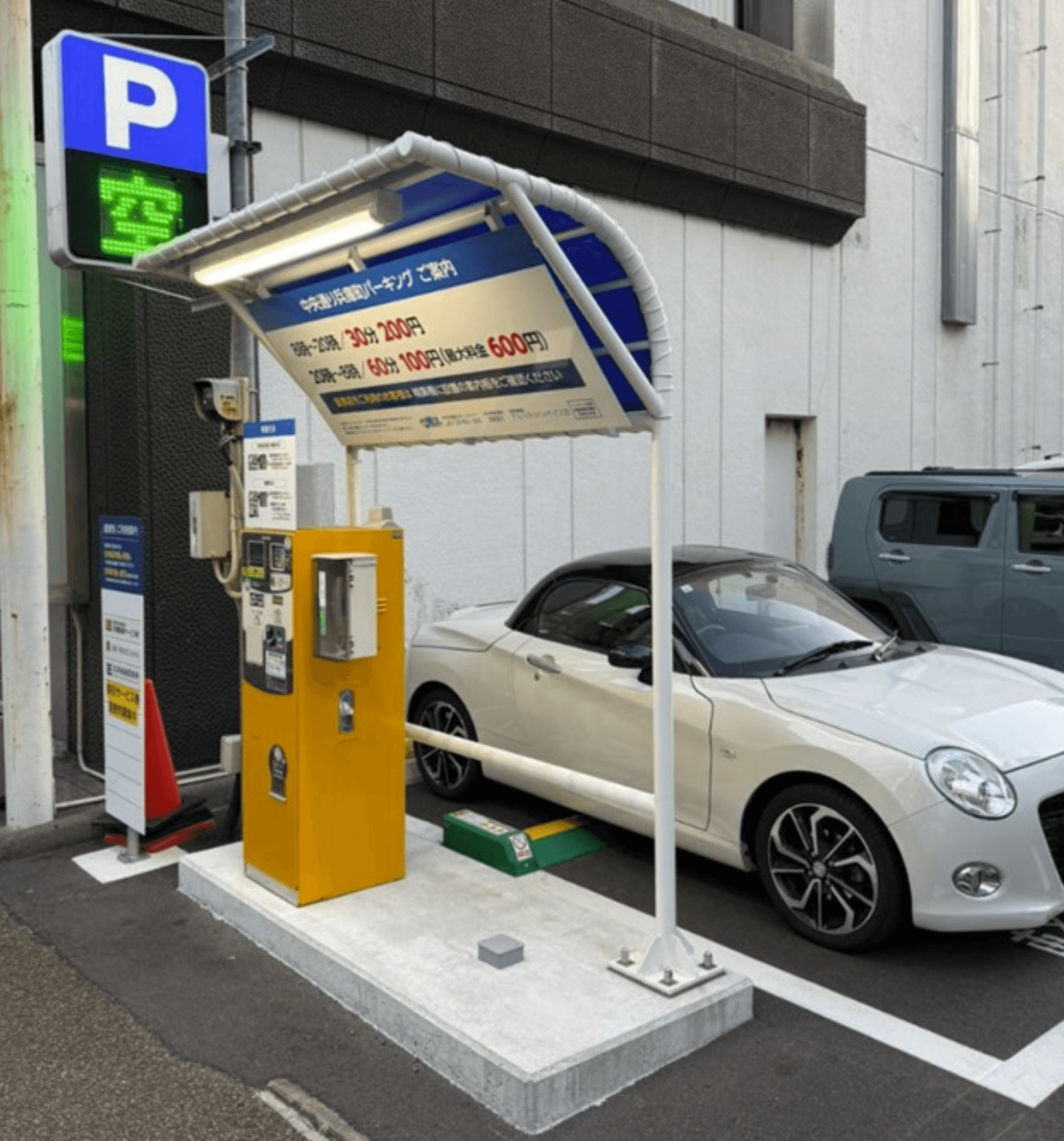
Example of a "locking plate" parking lot in Japan.
Renting a Car in Japan
Renting a car in Japan is generally easy and usually less expensive than renting vehicles in the US. I know our dominant American instinct is to drive enormous cars, but I urge you to opt for getting the smallest car you and your group will be comfortable in. Even in a small car, roads and parking spaces in Japan will feel narrow compared to in the United States. Also, book your rental car in advance for better deals and availability, especially if you’re traveling during peak seasons like cherry blossom or ski season.
Steps to Rent a Car:
Book Online: Our suggestion is to book online with international agencies like Toyota Rent-a-Car, Nippon, Orix, Times Car Rental, Nissan, Ekiren, or Budget. We don’t have partnerships with any car rental agencies in Japan, but my personal experience has been better with bigger rental companies. Local rental car companies sometimes have better deals, but it’s often even less likely that you’ll find staff who speak English, and you likely won’t have the benefit of nation-wide locations in case something happens to your car.
Pick up Your Car: Make sure you bring a copy of your reservation with you and check that the fees are all exactly as anticipated. An additional deposit is often put on your credit card, which you will have returned to you a few days after your rental if there’s no damage to your vehicle
Inspect Your Vehicle: Although this isn’t strictly necessary, it’s always a good idea to take a look around your car with a staff member to document any pre-existing damage your car might have. I’ve been charged for scrapes on a vehicle I’m pretty confident I wasn’t responsible for, so this is now something I always do.
Tips for First-Time Drivers in Japan
Opt for Automatic: Unless you’re used to driving a car with a manual transmission, it’s best to reduce the number of new challenges.
Practice First: Drive in a quiet area for a few minutes to get used to left-hand driving before going out on busy streets. I do this every time I pick up a car in Japan to reacclimate myself.
Know Gas Pump Colors: Although many gas stations in Japan are full-service, if you’re pumping your own gas, it’s important to know the nozzle colors for the three most common types of fuel. Regular gas is red, premium gas is yellow, and diesel is green.
Stay Alert in Rural Areas: Rural roads are often winding and narrow, so it’s important to watch for oncoming cars and wildlife, especially deer and foxes.
Cultural Driving Etiquette
Thank You Signal: Blink your hazard lights briefly to thank someone for letting you merge.
Be Patient: Japanese drivers are courteous and adhere to traffic rules. Aggressive driving is rare and frowned upon.
Emergency Preparedness
In case of an accident or breakdown:
Get to a safe place.
Call 110 for police or 119 for medical emergencies.
Notify your rental car provider immediately.
If another vehicle is involved, stay to exchange insurance and contact information.
Conclusion
I always find driving to be an incredibly enjoyable way to see any country, and Japan is no exception! With the right preparation, you’ll be ready for an unforgettable adventure. If there’s anything you’d like to have added to this guide, let us know so we can continue to make it a more helpful resource!